Peptides: The 125 Year "Overnight" Success!
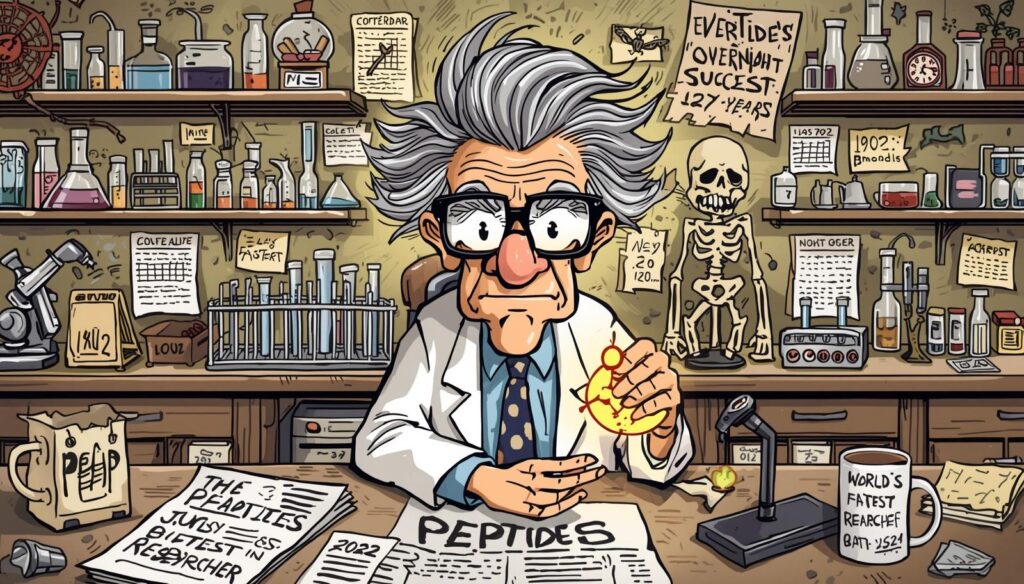
Is it just me, or did everyone wake up in 2026 and suddenly start talking about peptides like they’re the new avocado toast?
The landscape is split three ways. You have the dedicated proponents; the skeptics who hear ‘peptide’ and mistake it for a trendy, avoidable brand of bottled water; and the ‘regulatory enthusiasts’ who view these compounds as illegal ‘super-soldier’ serums. The latter group maintains a hard stance, primarily because the FDA has yet to grant its official seal of approval (and why would they?).
But here’s the reality check: we aren’t exactly reinventing the wheel. We’re just finally putting a motor on it.
A “Golden Age” (With a Very Long Prequel)
While the current peptide boom feels like a modern phenomenon fueled by the massive commercial success of GLP-1s (O Z E M P I C), the scientific journey actually spans over 125 years.
It started back in 1902 when Emil Fischer (a man who clearly loved a good chemistry set) confirmed the existence of the “peptide bond.” Fun fact: the word comes from the Greek peptein, meaning “to digest.” It’s the same root as Pepsi, though, to be clear, drinking a soda will not repair your torn rotator cuff.
The BPC-157 Paradox: A Legend in Regulatory Limbo
The most frustrating part of this “Golden Age” is the lack of seriousness regarding the actual benefits of peptides. It often feels like these tools are being intentionally kept at arm’s length.
Take BPC-157, for example. This little chain of 15 amino acids has been around for 30 years. For the uninitiated, its “claims to fame” are essentially the biological equivalent of a Swiss Army Knife:
The Mechanic: Accelerates healing in tendons, ligaments, and muscles.
The Plumber: Helps repair the gut lining (say goodbye to the “leaky gut” conversation).
The Electrician: Shows potential for neurological support and CNS recovery.
The Billion-Dollar Belly Ache
So, if this stuff has been floating around since the mid-90s, why did the FDA and Health Canada suddenly decide to move it to the “Naughty List” (Category 2)? Did it suddenly develop a bad attitude? Not exactly.
It turns out the biggest hurdle isn’t health, research or medical—it’s ROI.
Here is the awkward truth: This sequence is found in nature (specifically, your own gastric juice). Because Mother Nature isn’t big on filing paperwork, you can’t really patent her original work. And in the world of Big Pharma, if you can’t plant a “Keep Off the Grass” sign on a molecule, investors treat it like leftovers in the office fridge; nobody wants to touch it.
Essentially, we have a substance that could genuinely improve lives, but because it doesn’t offer a “get rich quick” patent scheme, it’s being left out in the cold. It’s a classic case of “It works, but does it make us yacht money?”
The Official Stance: “We don’t have enough human clinical trials to prove it won’t make your left ear fall off.”
The Unofficial Reality: Since it was primarily studied in animals for literally decades, health authorities cracked open an Orange Crush, bag of Doritos and hit the panic button. The “Biohacking Boom” caused its use to explode before the official (and very expensive) human trial paperwork was finished.
The 2026 Plot Twist
In a classic “wait, there’s more” moment, the regulatory landscape is shifting again as we speak. In February 2026, news broke that a legal challenge successfully argued that the FDA lacked a “safety signal” to justify banning many of these compounds. Rumour has it that BPC-157, GHK-Cu, and 12 others are being moved back to Category 1, meaning compounding pharmacies might finally be able to legally hand them over again.
The Bottom Line
Peptides aren’t “illegal drugs”; they are signalling molecules that your body already uses to speak to its cells, and we are finally learning how to join the conversation.
Whether you’re a business leader managing a high-pressure workflow or just someone trying to fix a cranky knee, it’s time we gave these building blocks the respect they’ve earned over the last century.
And look, if this isn’t for you, don’t take it. Nobody’s asking for your permission or your participation. But if you’re planning to spend your afternoon policing social media with your opinion, keep in mind: your skepticism isn’t a strategy, and quite frankly, no one cares. While you’re busy typing out a comment, the rest of us are busy getting back to work.